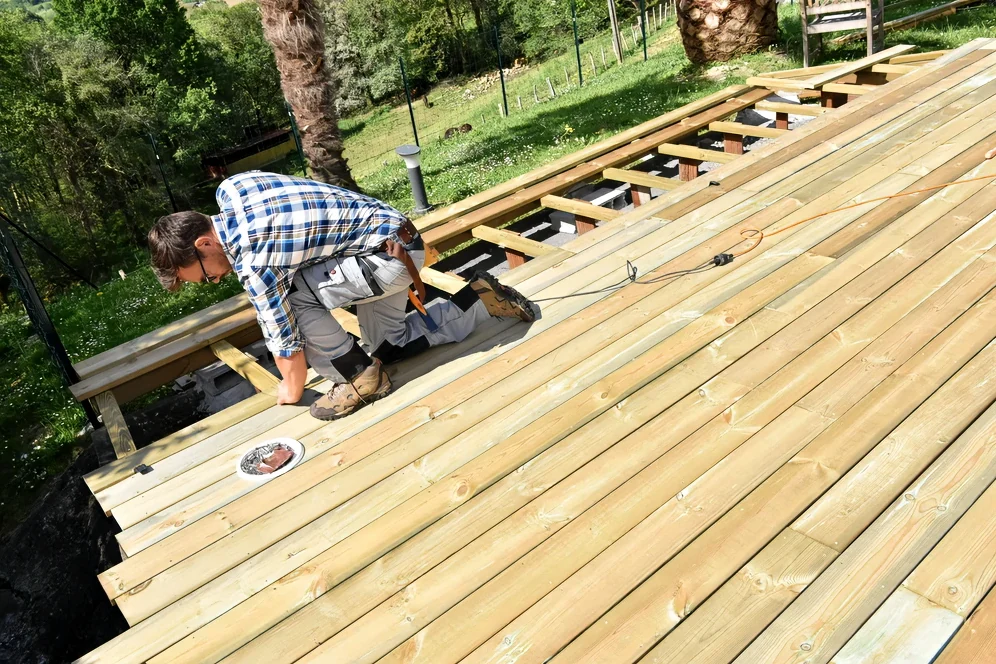
What are the signs you need Deck Repair?
Look for rotting wood, loose or wobbly railings, cracked or splintered boards, rusted fasteners, and visible mold or mildew. If your deck moves when you walk on it or you see mushrooms growing near the posts, you likely need repairs.
A deck that sags under your weight is telling you something is wrong. That bouncy feeling usually means the joists are rotting or the ledger board (the piece bolted to your house) has pulled away. In Birmingham's humid climate, moisture gets trapped where wood meets wood, and that's where decay starts first.
Check the railings. Grab the top rail near a post and give it a firm shake. If it moves more than an inch, the connections have loosened. A wobbly railing is a safety hazard, especially if you have kids or elderly visitors. The same goes for stairs: if the treads creak or shift, the stringers may be rotting from the bottom up.
Look at the surface of the boards. Cracks wider than a quarter inch let water seep into the wood core. Splinters are a nuisance, but deep cracks are a pathway for rot. In Birmingham, where summer thunderstorms dump an inch of rain in an hour, those cracks fill up fast and stay wet for days.
Mushrooms or fungus growing on the deck surface or around the base of posts means the wood is holding moisture and decaying. That's not just a cosmetic problem. It means the wood fibers are breaking down, and the structural strength is compromised. You can't just scrape it off and call it fixed.
Rusted screw heads and nail pops are common on older decks. When fasteners rust, they swell and push the wood up, creating trip hazards. More importantly, rusted fasteners lose their holding power. A deck held together with corroded screws is one heavy snow load or crowded party away from failure.
The warning signs to watch for
Rot at the post bases, loose ledger boards, soft spots on the decking, rusted flashing, and gaps between the house and the deck are all red flags. If you see any of these, call a professional for an inspection.
Start at the ground. The posts that support your deck sit on concrete piers or directly on the soil. In Birmingham, the clay soil holds moisture against the wood, and that constant dampness rots the bottom few inches of the post. Poke the base of each post with a screwdriver. If it sinks in more than a quarter inch, the post is rotting from the inside out.
The ledger board is the single most critical connection on your deck. It's the beam bolted to the side of your house that carries half the deck's weight. If the flashing above it is rusted or missing, water runs down the wall and soaks into the ledger. Over time, the wood rots and the bolts pull loose. A deck that separates from the house by even a quarter inch is dangerous.
Soft spots on the decking boards are easy to miss because the top surface can look fine while the underside is mush. Walk the entire deck in bare feet or socks. If you feel a spongy spot, mark it. That board needs to come out, and the joist underneath probably needs replacing too.
Check the flashing. Flashing is the metal or rubber strip that directs water away from the ledger board. If it's rusted, bent, or missing, water is getting behind it. You might see stains on the house siding below the deck. That's a sign the flashing has failed, and the ledger is getting wet every time it rains.
Gaps between the deck and the house are a structural issue. If you can see daylight between the ledger and the siding, the bolts have loosened or the wood has shrunk and rotted. Either way, the deck is no longer securely attached to your home. A gap wider than a pencil is a serious concern.
What causes these problems in Birmingham
Birmingham's hot, humid summers and frequent rain create the perfect conditions for wood rot, mold, and fastener corrosion. Clay soil traps moisture against posts, and poor initial installation often speeds up the damage.
Birmingham sits in a humid subtropical climate. From May through September, the humidity rarely drops below 60 percent, and afternoon thunderstorms are a near-daily occurrence. That constant moisture cycle means wood never fully dries out. A deck built with pressure-treated pine will absorb water, swell, then shrink as it dries, and over time that cycle cracks the wood and loosens the fasteners.
The clay soil in neighborhoods like Mountain Brook, Vestavia, and Homewood is dense and drains poorly. When it rains, water pools around the base of deck posts. If the posts are set directly in concrete without a gravel base or a proper pier, the water sits against the wood for days. That's why you see rot starting at the bottom of posts, not the top.
Poor installation is a big part of the problem. Many decks in Birmingham were built by handymen who didn't use galvanized fasteners or proper flashing. They nailed the ledger board to the siding instead of bolting it through to the rim joist. They set posts in concrete without a gravel drain. Those shortcuts work for a few years, then fail fast.
Shade makes it worse. Decks under large oak or pine trees stay damp longer because the sun never dries the surface. Moss and algae grow on the wood, trapping moisture against the surface. In Birmingham's older neighborhoods like Forest Park and Crestline, mature trees shade decks for most of the day, and those decks rot faster than ones in full sun.
Termites are a real concern here. Birmingham is in the heart of termite territory. If your deck has wood-to-ground contact, termites can move from the soil into the deck structure. They hollow out the wood from the inside, leaving a thin shell that looks fine until you step on it and your foot goes through.
What happens if you ignore the signs
Ignoring deck damage leads to structural failure, safety hazards, and much higher repair costs. A small rot repair can turn into a full deck replacement if you wait too long.
A small patch of rot on a deck board is a quick fix. A contractor can cut out the bad section and sister in a new piece of wood. But if you leave it, the rot spreads into the joist, then into the ledger, then into the house's rim joist. What could have been a two-hour repair becomes a week-long project that involves replacing framing and repairing siding.
Loose railings don't fix themselves. They get looser over time as people lean on them. A railing that fails when someone falls against it can cause a serious injury. In Birmingham, decks are often ten to fifteen feet off the ground because of the hilly terrain. A fall from that height onto clay or concrete is not something you want to risk.
A deck that pulls away from the house is a collapse waiting to happen. The ledger board connection is the most stressed part of the deck. If it fails, the entire deck can peel off the house like a loose shingle. That's not a slow process. It happens in an instant, usually when the deck is loaded with people and furniture.
Water damage doesn't stop at the deck. If the ledger board is rotting, water is also getting into the house's rim joist and sill plate. That can lead to rot in the floor joists inside your home, which is a much bigger and more expensive repair. You could end up replacing subfloor and flooring inside the house because you ignored a deck leak.
Insurance claims for deck collapses are often denied if the damage was visible and ignored. Homeowner's insurance typically covers sudden, accidental damage, not gradual deterioration. If an inspector finds that you knew about the rot and didn't fix it, the claim may be rejected. You're on the hook for the full cost of repairs.
Common questions about Deck Repair warning signs
Need deck repair in Birmingham? Get a free estimate today.
📞 205-851-8373