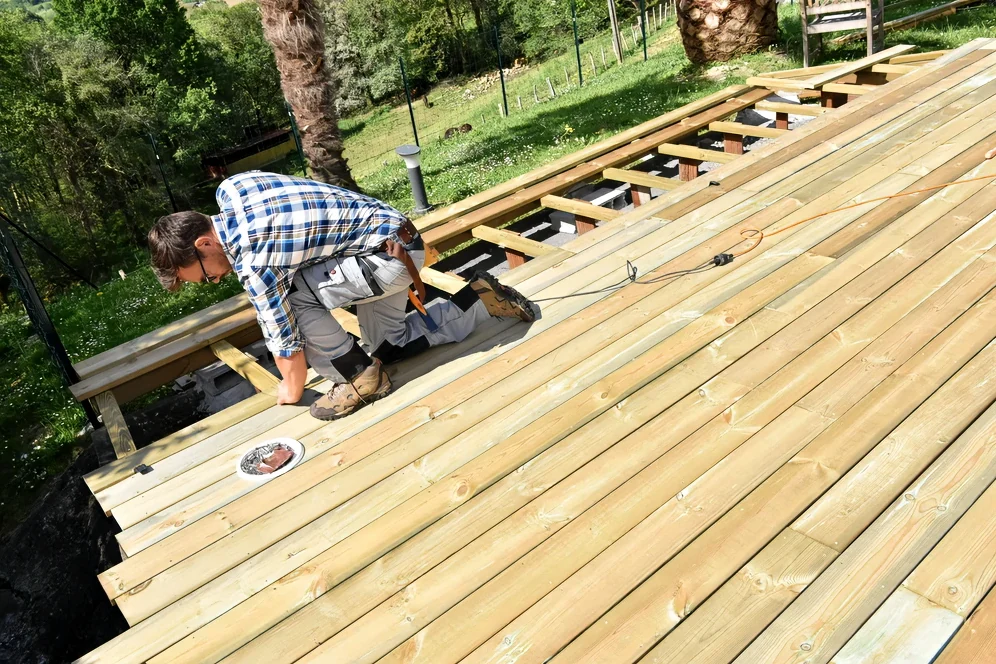
What is Deck Board Replacement and how does it work?
Deck board replacement is the process of removing rotted, split, or worn-out boards from your deck surface and installing new ones. It's not a full rebuild, but it can make a tired deck look new again and keep it safe for another decade.
Most Birmingham decks are built with pressure-treated southern yellow pine. That's a good wood for our climate, but it still rots when water sits on it. The first boards to go are usually the ones around the house wall where rain bounces off the brick, or the ones near the ground where sprinklers hit them every day. The rest of the deck might be fine, but those few bad boards turn into a tripping hazard and let water into the framing underneath.
Board replacement is not the same as resurfacing. Resurfacing means pulling every board off and starting fresh. Replacement means we pull only the bad ones, match the new wood to the old, and fasten them so they look like they belong. If your deck is more than 15 years old and half the boards are bad, resurfacing probably makes more sense. But if you have three or four rotted boards near the steps and the rest are solid, replacement is the smarter move.
We use a pry bar and a sawzall to get the old boards out. The tricky part is not damaging the joists underneath. A rotted board often has rotted fasteners, so the screws or nails break off. We cut the board flush with the joist and pull the fastener stubs out with a pair of channel locks. Then we check the joist itself. If the joist is soft, we replace that too. If it's solid, we clean it off and get ready for the new board.
New boards need to be the same thickness as the old ones. Most deck boards are five-quarters thick, which is actually one inch. Some older decks have 2x6s that are an inch and a half. If you mix thicknesses, you get a bumpy surface. We carry both thicknesses in our truck, but we always measure first. We also let the new boards sit on site for a couple days to acclimate to the humidity. Birmingham air is heavy, and wood moves. If you nail a dry board in August, it will shrink by November and leave a gap.
Fasteners matter more than most people think. We use coated deck screws, not nails. Nails work loose in a year or two, especially on a deck that gets afternoon sun in Vestavia or Mountain Brook. Screws hold tight. We also pre-drill near the ends of the board to keep it from splitting. A split end traps water and starts the rot cycle all over again.
Staining or sealing the new boards is optional but smart. The old boards have already weathered to a gray. New boards are bright yellow. You can let them gray naturally, or you can stain the whole deck to match. If you do stain, wait three to four weeks after installation so the wood has time to dry out. Stain over wet wood peels in six months.
How Deck Board Replacement works, step by step
We start by inspecting each board, then remove the bad ones, check the joists, cut and fit new boards, and fasten them with coated screws. The whole job on a typical 12x16 deck takes one to two days.
First, we walk the deck with you and mark every board that needs to go. We look for soft spots with a screwdriver, check for cupping and cracking, and see if the fasteners are pulling through. We also look at the ledger board where the deck meets the house. That's a common rot spot in Birmingham because the flashing is often missing or installed wrong. If the ledger is rotted, board replacement turns into a bigger repair.
Once we know what we're pulling, we set up a debris chute or a tarp to catch the old wood. Deck boards come off fast with a demolition bar. We work from the house outward so we don't have to walk on boards that are about to be removed. Each old board gets cut into manageable lengths and tossed into the trailer.
With the old boards gone, we clean the joists. Birmingham humidity means joists often have a thin layer of surface mold. We wire-brush that off and treat the area with a borate solution that stops rot without hurting the wood. If any joist has a soft spot, we cut out the bad section and sister a new piece of pressure-treated lumber alongside it. Sistering means bolting a new joist to the old one. It's stronger than patching and doesn't require pulling the whole joist out.
New boards get cut to length on site. We leave a quarter-inch gap between each board for drainage. That gap is critical. Birmingham gets 50 inches of rain a year, and if water can't drain between the boards, it sits on top and rots them fast. We also leave a half-inch gap at the ends of the boards where they meet the house or the rim joist. That lets air move and keeps the ends dry.
Fastening starts at one end and works across. We put two screws at every joist crossing. That's about 60 screws for a 12-foot board on a 16-inch joist spacing. We countersink the screws just below the surface so they don't snag bare feet. If the deck is getting stained later, we fill the screw holes with wood filler that matches the stain color.
The last step is a final inspection. We walk every board, check for squeaks, and make sure all fasteners are flush. We also check the railing and the stairs because those are the most likely spots to have hidden rot. If the railing post is loose because the base is rotted, we tell you then. We don't leave that for you to find later.
Why Deck Board Replacement matters for your home
Bad deck boards are a safety hazard and a water problem. Replacing them keeps your family from tripping, stops rot from spreading to the frame, and keeps your deck usable for years instead of needing a full tear-off.
A rotted board can collapse under a person's weight. It doesn't happen often, but when it does, someone gets hurt. The boards that rot first are usually the ones people walk on most. The path from the back door to the grill, the step down to the yard, the spot where the dog sleeps. Those boards get constant traffic and moisture. Replacing them before they fail is cheap insurance.
Rot spreads. If a deck board is rotted against a joist, that joist starts to rot too. Once the joist goes, the board above it gets no support, and the rot moves to the next joist. What starts as a two-board replacement can turn into a full frame rebuild if you wait too long. Catching it early saves the structure.
Birmingham's clay soil holds water against the bottom of deck posts. That moisture wicks up into the framing and then into the deck boards. If you have boards that are rotted near the ground but fine up top, that's a sign the posts are starting to go. Replacing the boards gives us a chance to check the posts and add a post base or a gravel bed to keep the wood dry.
A deck with missing or rotted boards lowers the value of your home. Buyers notice. A real estate agent will flag it in a disclosure. If you're thinking about selling in the next couple years, replacing the bad boards now is cheaper than negotiating a credit at closing. It also makes the house look better when you're showing it.
There's also the nuisance factor. Splinters, popped nails, boards that wobble when you step on them. Those things make you not want to use your deck. A simple board replacement fixes all of that. You get a smooth, solid surface that feels good under bare feet and doesn't snag your chair legs.
Common problems and what causes them
The most common problems we see in Birmingham decks are rot from trapped moisture, cupping from sun exposure, and fastener failure. Each has a specific cause and a fix that works for our climate.
Rot at the house wall is the number one problem. The ledger board is supposed to be flashed with metal that directs water away from the house. In Birmingham, a lot of decks were built without any flashing at all. Water runs down the siding, hits the deck, and soaks into the end grain of the ledger. That rot moves into the joists and then into the deck boards. If your deck boards are soft right where they meet the house, that's what's happening.
Cupping happens when the top of a board dries faster than the bottom. On a south-facing deck in Homewood, the sun bakes the top of the boards while the bottom stays damp from shade and humidity. The board curls up at the edges. Cupped boards hold water in the middle, which makes them rot faster. The fix is to replace them with boards that have the growth rings oriented correctly, or switch to a composite board that doesn't cup.
Fastener failure is subtle. Nails work loose over time, especially on a deck that gets heavy use. You step on a board and it squeaks. That squeak is the nail moving in the hole. Eventually the nail pulls out enough that the board lifts. Then water gets under it and rot starts. The fix is to replace the nails with screws. But if the board is already rotted around the nail hole, the board has to go too.
We also see boards that were installed too tight. If you butt the boards against each other with no gap, they expand when they get wet and buckle. Buckled boards crack and trap water. The standard gap is a quarter inch. If your deck boards are touching each other, they need to be replaced with proper spacing.
Another issue is boards that are too long for their span. If a deck board is 16 feet long but the joists are only 12 inches apart, the board will sag between the joists over time. That sag creates a low spot where water pools. Pooled water rots the board from the top down. We see this on decks that were built with leftover lumber from a bigger job. The fix is to replace the long boards with ones cut to the right length for the span.
Common questions about Deck Board Replacement
Need deck repair in Birmingham? Get a free estimate today.
📞 205-851-8373